


Key Takeaways
 A raid worth KSh 15 million to 20 million at RNG Plaza turned one trader's loss into a national argument about fakes.
- Most people who buy counterfeit sneakers aren't fooled. About 78 percent buy on price, and most know exactly what they're getting.
- A copy sells for around KSh 1,500. A genuine Nike runs about KSh 19,000. That gap is the whole story.
- Counterfeiting costs Kenya up to KSh 100 billion a year, and the state around KSh 40 billion in taxes.
- There's a legal way up: register a real brand with KIPI and build something that can't be cleared off a shelf in one morning.
The video is just a phone panning across empty shelves. No shoes, no boxes, no customers. Shiquo Wa Hii Style filmed it herself at her RNG Plaza shop, and within hours it was everywhere.
Officers, she said, had carted away millions of shillings of sneakers over claims they were counterfeit. What spread next wasn't only sympathy.
It was an argument about Nairobi's counterfeit sneaker trade, a trade most young Kenyans touch and few discuss honestly.
01. The Raid That Started the Argument.
Here's what we can say for sure. On or around 9 June 2026, officers arrived at Shiquo's shoe shop at RNG Plaza in Nairobi's CBD.
They took shoes and apparel that several outlets valued at between KSh 15 million and KSh 20 million, much of it alleged fakes of brands like Nike.
Then the story split in two. Citizen Digital reported that the Anti-Counterfeit Authority confirmed an operation, describing it as intelligence-led enforcement rather than a targeted campaign.
A day later, the ACA's Director of Enforcement, Osman Yusuf, told the Daily Nation something very different.
“There is no operation that was conducted by ACA at that shop. That is a pure lie.”
His claim was that Shiquo was moving between shops and used the empty shelves to stage a raid that never happened. She stood by her account in an emotional video.
Both versions can't be true, and no one has cleanly squared them. For a generation that trusts neither influencers nor institutions on instinct, that gap is the whole story.
02. The Ksh 1,500 Sneaker, Explained.
Shiquo didn't get big by accident. She built a following by selling trendy sneakers cheap, around KSh 1,500 a pair or less, whatever the style. She imports in volume from China, sells fast on TikTok lives, and runs constant discounts. By her own account, she made her first million at 19.
Look at the maths and the appeal is obvious. A genuine pair of Nike runs about KSh 19,000 at an official outlet like the brand's new store at Sarit Centre. Shiquo's version costs a fraction of that. The cheap pair isn't a discount on the real thing. It's a different product, aimed at people the real thing was never priced for.
Nike only opened its first official Kenyan store, at Sarit Centre in Westlands, in May 2026. For most young buyers, the authentic pair arrived already priced out of reach.
A KSh 1,500 shoe against a KSh 19,000 one isn't a discount. It's a different market.
That model isn't unique to her. It's the engine of a whole layer of Nairobi retail, from CBD plazas to Instagram shops. It employs people, moves stock weekly, and answers genuine demand.
Holding that truth next to the legal problem is the only honest way to tell this story.
03. From a Chinese Factory to an RNG Plaza Shelf.
The shoe on that shelf travelled a long way. Most counterfeit sneakers in Kenya start in factories in China, the country named as the largest single source of fakes reaching Kenya. From there they move through importers and clearing agents into the country.
Inside Nairobi, the trade has a clear spine. It runs from importers at the Mombasa port through markets like Kamukunji and Eastleigh, then feeds retail outlets across the CBD, including plazas like RNG. The same pair can pass through several hands before a customer ever sees it.
China sits at the centre for a simple reason. Its factories can copy a popular design and ship it in bulk faster and cheaper than the original brand can stock a local store. That speed is the supply chain's whole advantage.
There's a grievance buried in here too. Many traders pay duty and rent, then watch their stock get seized anyway. You can think counterfeiting is wrong and still see why that feels unfair to the person standing in the empty shop.
04. Who Actually Buys Fake Sneakers in Nairobi.
The easy assumption is that fakes fool people. They mostly don't. According to figures cited by the Anti-Counterfeit Authority, about 78 percent of consumers buy counterfeit goods because of price. More than 70 percent buy them knowingly.
Picture who that is in Nairobi. A student who wants the look without three months' rent on one pair. A first-jobber building a wardrobe on a starting salary. Someone who refuses to pay original prices for a shoe that scuffs on a matatu floor anyway.
These are real people. Bana Kenya reported one regular shopper, Mercy, who keeps going back to Shiquo for exactly this reason: the prices let her refresh her wardrobe without skipping rent.
When the raid hit, Nairobi split. Some praised Shiquo for keeping fashion within reach, and for the young people her supply chain employs. Others said fakes cheat real designers and starve the taxman. A few asked why she, of all traders, got singled out.
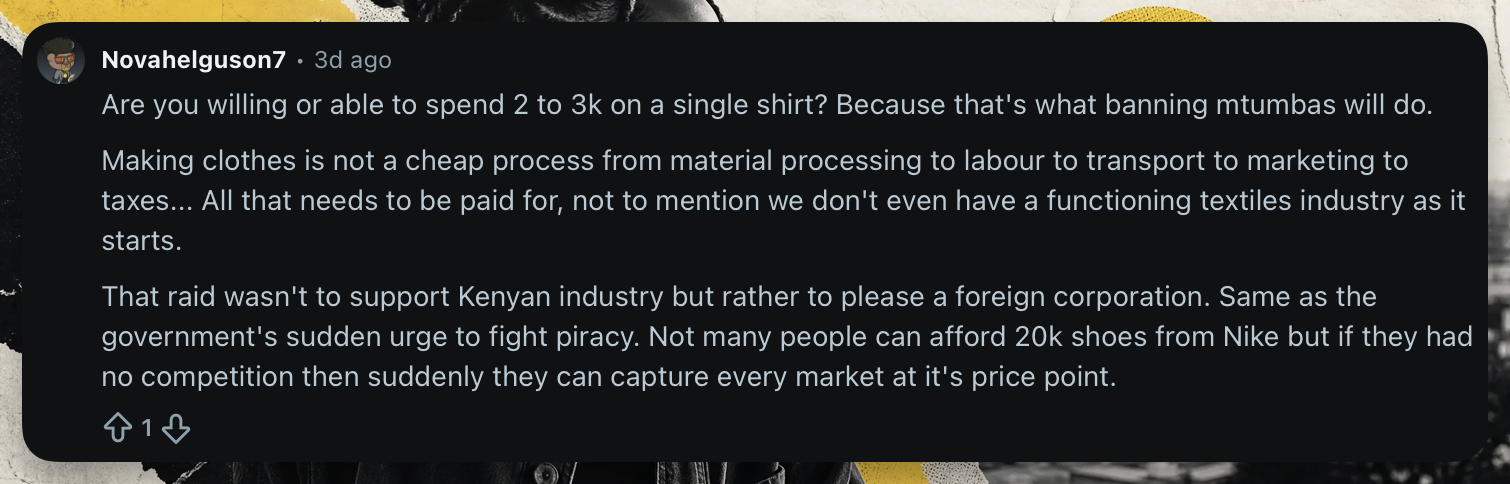 None of this means the law disappears. But if you want to understand the trade, start here, with people doing the math rather than getting tricked.
05. What It Costs Kenya.
Zoom out and the numbers get heavy. Kenya loses an estimated KSh 85 billion to KSh 100 billion a year to counterfeiting. The state loses around KSh 40 billion of that in taxes. In 2025, the United States' Special 301 Report again flagged Kenya as a hotspot for fake goods.
By the numbers. Up to KSh 100 billion lost a year. Around KSh 40 billion in lost taxes. 78 percent of buyers choose fakes on price. A copy goes for around KSh 1,500 against about KSh 19,000 for a genuine Nike. One trader's loss in this story: KSh 15 to 20 million.
Those losses are real, and so is the other side. For many young Kenyans, fakes are how they take part in fashion at all.
The country loses billions. So does the trader. Both things are true.
Hold both at once and you understand the trade. Pretend otherwise and you get the lazy version most coverage settled for. There's a quality cost too: cheaper materials can mean shoes that fall apart fast or hurt your feet over time.
06. What the Anti-Counterfeit Authority Can Actually Do.
Can the Anti-Counterfeit Authority seize goods without a court order?
Yes. Under Section 23 of the Anti-Counterfeit Act, 2008, ACA inspectors can enter premises, search, seize and detain goods they reasonably suspect are counterfeit, with no court ruling, to preserve evidence while investigations continue.
That power has limits. The seizure starts a process, it doesn't end one. Traders have the right to prove their goods are genuine. If investigations show the stock is authentic and breaks no trademark, the goods go back to the owner.
The Authority, led by Executive Director Dr. Robi Mbugua Njoroge, frames this as protecting both consumers and legitimate brands. In plain terms, officers can clear your shelves on suspicion, but they have to document what they take and let the evidence decide what happens next. Knowing that line matters if you ever land on the wrong side of it.
07. What to Do if Your Shop Gets Raided.
If officers ever walk into your shop, panic is the worst plan. Here's the practical version, drawn from the Anti-Counterfeit Authority's own guidance.
Ask for ID. Request the officer's Certificate of Authority, known as Form ACA 1, to confirm the raid is legitimate.
Demand an inventory. You're entitled to a full written list of everything taken, recorded on Form ACA 2.
Write everything down. Note officer names, badge numbers, and the date and time of the raid.
Keep your paperwork. Invoices, supplier details and import records can prove your goods are genuine.
Don't hide or move stock. Tampering during a raid is itself an offence and only makes things worse.
Call a lawyer fast. Get legal advice before you decide your next move.
After that, the goods go into storage or get sealed on site. The ACA verifies them with the brand owners. If they're confirmed fake, they're forfeited to the state and usually destroyed by incineration or shredding, recorded on a destruction certificate called Form ACA 16.
08. The Other Road: Building Your Own Brand.
Buried in Shiquo's own response was the more interesting part. She talked about starting her own brand, designing a shoe, putting her own name on it. The Anti-Counterfeit Authority, for once, agreed, and pointed her toward registering with the Kenya Industrial Property Institute, or KIPI.
She put it plainly in one of her videos: she could design a shoe under her own brand and use it to back local football clubs. That's a different game from importing copies, and a slower one.
The route works. You create a name and a logo, register the trademark through KIPI, and you get legal protection against anyone copying it. It turns a hustle into something the law will actually defend.
A fake can be seized in a morning. A brand that's yours can't.
Be honest about the trade-off, though. Building a brand is slower and harder than ordering a container of copies. There's no flat-price shortcut. But a brand that belongs to you can't be cleared off a shelf for belonging to someone else.
09. What the Shiquo Story Says About Young Kenyan Hustle.
Strip away the drama and this was never really about one shop. It's about how a generation builds money under tight constraints. Priced out of the originals, young Kenyans built a parallel market for the look they wanted.
That's not laziness or dishonesty. It's improvisation inside a system that never made room for them at full price. The fake sneaker economy in Nairobi is what happens when ambition meets a wallet that won't stretch.
Shiquo says she'll start over. “I am starting again, customer, let us start together,” she told her followers after the raid.
The story doesn't end with a verdict, and it shouldn't. Untitled Media exists to document exactly this kind of in-between moment, when the rules and the reality don't match yet.
The Honest Way Out Is Slow.
So the raid told us less about Shiquo than about the rest of us.
Behind one emptied shop sits Nairobi's fake sneaker economy: built by young people the originals were never priced for, policed by a law that can clear a shelf on suspicion, and quietly funding a lot of first wardrobes.
The way out isn't a cheaper fake. It's a real brand with your own name on it, registered and protected.
Add your voice. You've probably touched this trade, as a buyer, a seller, or someone who watched it happen. We want the version the headlines missed. Send us your story at the Submit page, anonymously if you'd rather.
Tags


